Keeping Up With Generative AI
Part 1 — the opportunity for insurers

Generative artificial intelligence (AI) has arrived in force and has the potential to transform many ways insurers do business. Poster child of the age of acceleration, it has gained daily media coverage, and its possibilities have captivated headlines.
Earlier this year, we explored the fundamentals of generative AI and the impact it may have in the insurance industry, as we saw many insurers experimenting with its potential. We are now seeing industry discussions progressively shifting away from “What is generative AI?” to “What can I do with generative AI that is impactful, and how soon can this impact be delivered?”. In this five part article series, we will explore the world of generative AI through the lens of insurance industry leaders, addressing practical questions with the goal of helping the industry move forward — thoughtfully — on the impact curve.
Our initial edition discusses the generative AI opportunity for insurers, how significant generative AI will be for insurance organizations’ business strategies and ways-of-working, and how quickly the impact is likely to materialize. Below is an excerpt of our report. Please click here to read our full version of Keeping up with Generative AI.
In this article, we cover the following questions:



A recent Celent survey found that by the end of 2023, half of insurers will have tested generative AI solutions, with more than 25% of insurers planning to have solutions in production by year-end. These numbers are significantly higher for larger insurance companies, and are likely to keep increasing as enterprise generative AI solutions and platforms proliferate and become more accessible.
However, the speed at which the technology is evolving requires leaders and teams to “learn as they go,” both around “what to do” and “how to implement the models, tools, and solutions.” While the short-term benefits are still unclear, we believe it is important for insurers to continue experimenting, exploring, and the scaling potential of certain solutions in order to stay ahead of the curve, and gain a potential first-mover advantage.
Unlike prior disruptive technologies — such as the internet, mobile, cloud, low code and no code, or even blockchain — whose mere early adoption took years to materialize, generative AI fostered large scale experimentation practically overnight. This was driven by a combination of ease of access to consumer solutions (such as OpenAI's ChatGPT or Google's Bard), worldwide media coverage, and the promise of near-instant benefits (however real).
Over the last few months, Big Tech players have announced their “horse in the race,” and are testing their way to right, with many growing pains along the way. From issues during live demos to fast-tracked beta releases, most Big Tech outlets pushed their products to market as quickly as possible, increasing potential risks around the short-term use of their technology.
Many enterprise solutions remain primarily focused on experimentation-type use cases, with major compliance, privacy and technology considerations — among others — yet to be resolved. LinkedIn’s co-founder Reid Hoffman notoriously stated that, “If you’re not embarrassed by the first version of your product, you’ve launched too late”— and many players in the generative AI race seem to have taken this to heart, but are now dealing with an enterprise world that is used to leveraging more “finished” products, and where large-scale pilots and rollouts come with a range of adoption challenges in the best of instances.
Similar to most technology disruptions, many technology players of all sizes and capabilities are rapidly announcing new generative AI solutions aimed at enterprise use cases for insurers. More than ever, it will be critical for insurers to assess potential generative AI solution providers and partners using a structured process (including due diligence and proof-of-concept development) in order to distinguish between “real” solutions from shiny objects, as well as identify the most efficient and effective partners.
Realizing material gains from generative AI will require significant changes in ways of working. Early pilots may require guardrails that reduce — or even counter — expected productivity gains in limited settings. Yet, persevering through short-term challenges may be crucial to gain a first-mover advantage and achieve long term success.





Insurance “Demand-side” hints at AI as a top objective in future-proofing organizations. According to a recent Oliver Wyman C-Suite survey on future growth opportunities, AI and digital strategy are the number 1 priorities for organizations that have already achieved their transformation objectives (compared to companies that have not, where it is more of a number 4 priority). Management attention on generative AI is substantial at the moment, hinting at continued interest and investment.
Technology “supply-side” hints at a “new normal” following early growing pains. While the current environment indicates a lot of uncertainty and risks, there will definitely be a “before” and “after” ChatGPT, with AI currently experiencing its “iPhone moment.” The technology offers the power to change how we work, produce and interact with content — similar to the way the iPhone changed how we communicate, share information, make purchases, snap photos, and access the internet.
We anticipate enterprise and customer-facing solutions to incorporate generative AI in various forms in 2024 and beyond, based on the solid trend that has started to emerge in the first few months of 2023.




Generative AI is not merely a replacement for underwriters, agents, brokers, actuaries, claims adjusters, or customer service representatives. Rather, it is an opportunity to create new operational efficiencies, build greater customer satisfaction, and empower employees to focus on value-added activities.
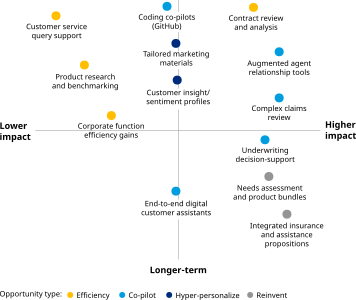
Generative AI can help streamline repetitive or manual tasks so employees can focus on higher value-add activities. Efficiency opportunities include customer service query support, product research and benchmarking, agent training using synthetic customer queries, corporate function efficiency gains: Similar opportunities exist across legal, compliance, finance, human resources, etc.
Generative AI has the power to automate “mundane” adjuster tasks and to make adjusters’ jobs more efficient and focused on driving outcomes versus documenting file and updating management
Potential for ~5% to 20% time saving benefits (depending on type of claim, line of business, and the percentage of documentation that can be automated)
Source: Oliver Wyman analysis
Generative AI technology offers an instant feedback loop of information, allowing insurers to analyze customer insights or quickly solve an issue across multiple mediums including emails, website interactions, and customer service discussions. Insights can be produced in shorter timeframes — from seconds, minutes, and hours, rather than multiple days or weeks.
This offers a powerful co-pilot for underwriters, claim adjusters, agents and other roles, which can augment human expertise and help accelerate complex decision-making. Many of these roles rely on large amount of expertise that cannot be replaced by rules-based algorithms. Generative AI can help accelerate experts’ analyses and assessments.
Within the marketing and distribution part of the value chain, generative AI can help insurers identify upgrades, add-ons, smarter and more targeted products to sell to customers — ultimately generating new revenue streams. Sales team can leverage generative AI to create effective sales lead lists, craft compelling, personalized sales scripts, and generate customized follow-up materials (for example, emails, marketing graphics, and messages). AI offers deeper insights on customer behaviors, helps develop more personalized customer experiences, and can support teams efficiently manage pricing, logistics, and product distributions.
The combination of generative AI use cases to create efficiencies, “co-pilots,” and hyper-personalization along with other technology, operation and behavioral changes, may lead to brand new opportunities for the industry. These offer a potential to reinvent the entire insurance value chain, and transform the role of the insurer altogether. While these opportunities are practically boundless and further out for the future, below are a few potential reinvention examples.
In the shorter-term, we anticipate that generative AI will materialize in more targeted areas within insurers’ organizations and value chains. These focus areas need to meet a set of materiality, feasibility, and organizational readiness criteria, as well as, be an initial beacon for scaling to more transformative solutions in the foreseeable future.
These shorter-term ambitions may include:
These initial solutions will be the first step towards generating broader outcomes, such as the end-to-end transformation of complex claims management or large account underwriting reviews. We also anticipate new business value propositions combining the power of efficiency, augmentation and hyper-personalization, such as the ability to rapidly develop highly customized small business insurance propositions at scale.
Unlock the power of generative AI
In the series' upcoming articles, we will explore questions around business value creation and new ways of working. We’ll help you unlock the power of generative AI, and take a deep dive into specific use cases and actions for your organization.
At Oliver Wyman, we help our clients think critically about generative AI opportunities across the value chain, pilot and scale use cases, and set up programs and portfolios to deliver immediate and long-term impact. This includes value proposition development, solution design and build, operating model design, talent and workforce considerations, capabilities, models, and processes, licensing and partnerships, and adopting best risk and governance practices across the business.
Read our Reinventing Insurance perspective